
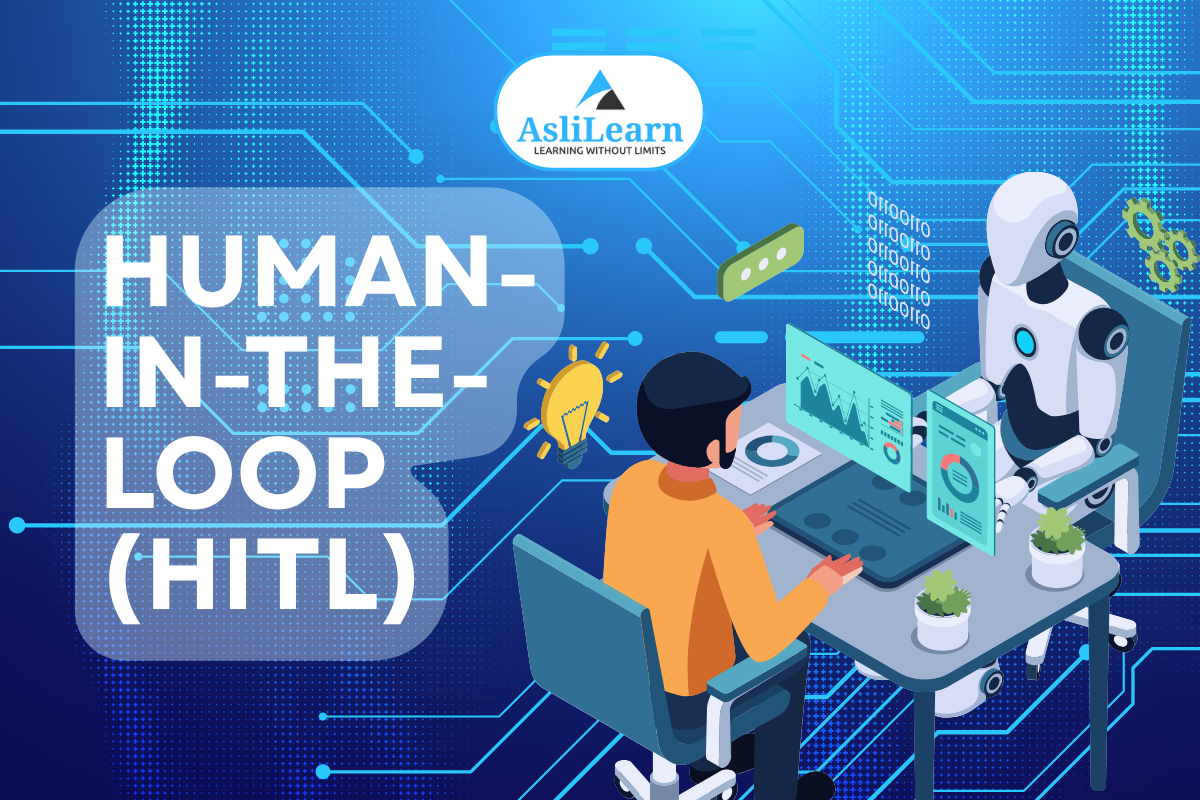
How human expertise and intelligent automation work together to build reliable AI systems
Introduction: AI Can Process Data, But Can It Always Understand the Context?
Artificial Intelligence has transformed how organizations collect, process, analyze, and interpret data. It can identify patterns across millions of records, summarize complex information, and automate tasks that once took hours of expensive manual effort.
But there is a crucial question we have to ask:
What happens when an AI system produces an answer that is technically correct but contextually wrong?
A Generative AI application may produce a well-written response containing incorrect information. An automated fraud detection system may flag a legitimate transaction as suspicious. A data pipeline may process millions of records successfully while silently carrying forward inaccurate or incomplete information.
In each case, the system may be operating exactly as designed, yet the outcome may still be wrong.
This is where the concept of Human-in-the-Loop (HITL) becomes important.
In our previous article, Why We Only Teach Data Science & AI, we discussed why the future of technology lies in understanding data, building intelligent systems, and using AI to solve real-world problems. HITL takes this discussion one step further: it explores how human expertise can become an integral part of the technical architecture of AI systems rather than remaining outside the process.
The objective is not to reduce the capabilities of AI. It is to design systems that combine machine efficiency with human judgment where it matters most.
1. What Is Human-in-the-Loop (HITL)?
Human-in-the-Loop is an approach to designing and operating AI systems in which humans actively participate in selected stages of the system’s lifecycle.
Depending on the application, human involvement may include:
- Reviewing and correcting training data.
- Labeling datasets for supervised learning.
- Validating model predictions & AI generated responses
- Correcting incorrect classifications.
- Approving high-impact or sensitive decisions.
- Providing feedback that improves future model performance.
- Monitoring deployed systems and investigating unexpected outcomes.
From a technical perspective, HITL creates a feedback mechanism between human expertise and machine intelligence. Instead of treating AI as an isolated component that receives input and generates output, we design a workflow in which human feedback can influence data quality, model development, decision-making, and subsequent system improvements.
A simplified representation looks like this:
Data → AI Model → Prediction or Output → Human Review → Feedback → Improved System
However, HITL does not mean that a human must approve every operation performed by an AI system. That would defeat the purpose of automation. The real objective is to determine where human intervention provides measurable value, and where automated execution is sufficiently reliable.
2. Where Does HITL Fit in the AI Architecture?
An AI application is not simply an algorithm. It is a collection of interconnected components that may include data ingestion, preprocessing, feature engineering, model training, inference, application integration, monitoring, feedback management, and more. Human intervention can be introduced at several points in this architecture.
Data Collection and Data Validation
Every AI model depends on the quality and relevance of the data it receives.
Consider an organization developing a machine learning model to predict customer churn. The dataset may contain customer activity, subscription history, support tickets, payment records, & cancellations. But what if cancellation dates are missing? What if multiple records exist for the same customer? What if the definition of an inactive customer differs between departments?
A data pipeline may successfully analyze & process these records without identifying every business-level inconsistency. Human experts can help define data quality rules, investigate anomalies, validate assumptions, and determine whether the dataset represents the real-world problem accurately.
Technically, this may involve:
- Schema and constraint validation.
- Missing-value and outlier analysis.
- Duplicate-record detection.
- Domain-specific validation rules.
- Human review of anomalous or ambiguous records.
In a nutshell: automated validation handles predictable errors; human expertise investigates cases where the meaning of the data is unclear.
Data Annotation and Labeling
Supervised machine learning requires examples associated with meaningful labels. A fraud detection model needs labeled examples of fraudulent and legitimate transactions. A medical image classifier requires appropriately labeled images. A sentiment analysis model needs examples of positive, negative, or neutral sentiment.
But labeling is not always straightforward. A customer complaint may express frustration without explicitly requesting a refund (we’ve all been there). A transaction may look suspicious but be legitimate. A document may contain language that can be interpreted differently depending on its context.
Human annotators and domain experts can review ambiguous cases and create more reliable labels.
In an advanced HITL workflow, the model itself can identify low-confidence predictions or examples where different models disagree. Those cases are routed to human reviewers, whose corrections are stored for future training or evaluation. This concentrates human effort on the examples most likely to improve the model, instead of spreading it across every record.
An important emphasis: this does not mean these models will eventually replace humans. Corrections and retraining will improve the system, but new situations the model is unsure about will keep rising with every new interaction. Uncertainty never fully goes away, and that is precisely where human judgement stays essential.
Model Training and Evaluation
During model development, data scientists evaluate whether a model learns useful patterns and generalizes to previously unseen data. Human involvement is important when choosing evaluation criteria, interpreting errors, examining data leakage, assessing bias, and deciding whether the model is suitable for deployment.
Suppose a model achieves 98% accuracy on a classification task. That sounds impressive. But if the model is identifying fraudulent transactions in a dataset where only 2% of transactions are fraudulent, a model that predicts every transaction as legitimate would also achieve 98% accuracy, without detecting any fraud at all.
This is why accuracy alone is insufficient. Depending on the problem, data scientists may need to examine precision, recall, F1-score, calibration, false-positive rates, false-negative rates, and performance across different population groups.
Human experts must determine which errors matter most in the business context, and whether the model meets the required performance thresholds. The model produces metrics; technical expertise determines what those metrics mean for the intended application.
Inference and Decision-Making
Inference is the stage at which a trained model processes new input and generates predictions or outputs.
In many applications, inference can be fully automated. A recommendation engine does not necessarily need a person to approve every product suggestion. But, when an AI output can trigger a consequential action, the architecture may require a human approval step.
For example, an AI system might recommend that a financial transaction be investigated. The system can generate a risk score and explain the signals behind it, while an authorized analyst reviews the evidence before taking action. Similarly, a Generative AI system may draft a technical report, but an engineer may need to verify its conclusions before the report informs a critical operational decision.
In these situations, the human does not replace the AI model. The human evaluates the output within a broader context that the model may not fully capture.
3. HITL in Machine Learning: A Technical Example
Let’s walk through a practical use case: building an AI-powered fraud detection system. The objective is to identify potentially fraudulent transactions while minimizing unnecessary alerts against legitimate customers.
Step 1: Data ingestion. Transaction records are collected from relevant systems and processed through a data pipeline. The pipeline performs schema validation, removes duplicates, handles missing values according to defined rules, and prepares the data for model development.
Step 2: Model prediction. A trained classification model evaluates each transaction and generates a fraud probability, say a score between 0 and 1:
- 0.08 — relatively low estimated risk
- 0.54 — intermediate estimated risk
- 0.96 — high estimated risk
These numbers are illustrative, not universal thresholds. A model’s probability estimates must be validated and calibrated before being interpreted as meaningful probabilities.
Step 3: Risk-based routing. The application uses configurable policies to decide what happens next. Low-risk transactions may proceed automatically, subject to applicable controls. Intermediate-risk transactions may be routed to a fraud analyst. High-risk transactions may trigger additional verification or a review workflow, depending on the organization’s policy. Importantly, a high model score does not automatically establish that fraud has occurred.
Step 4: Human investigation. The analyst examines additional evidence: transaction history, account activity, device signals, and other authorized information. The analyst can confirm the alert, dismiss it, or request further investigation. The decision and its supporting rationale are recorded.
Step 5: Feedback and improvement. Confirmed outcomes are added to a feedback dataset. After quality checks and suitable review, these records can be used to evaluate future model versions or retrain the model. The updated model is tested before being deployed.
This creates a continuous improvement cycle:
Ingest → Predict → Route → Review → Record Feedback → Evaluate → Improve
The key technical point: human feedback is not merely a comment. It becomes structured information that can support measurable improvements in the system.
4. HITL in Generative AI and Large Language Models
HITL becomes particularly relevant with Large Language Models (LLMs) and Generative AI applications. Unlike conventional classification models, which return a label or score, LLMs generate text, code, summaries, explanations, and other content. These outputs can appear fluent and authoritative even when they contain factual errors, unsupported assumptions, or incomplete reasoning.
Consider an enterprise AI assistant that answers employee questions using internal documentation. The application may use Retrieval-Augmented Generation (RAG), in which relevant documents are retrieved from a knowledge base and supplied to the LLM as context.
A simplified architecture is:
User Query → Document Retrieval → Context Construction → LLM Response → Validation → User
Where appropriate, a human review step can be inserted before the response is released or before the response triggers an action. For example:
- An employee asks a question about an internal IT policy.
- The retrieval system searches approved documentation.
- The LLM generates an answer based on the retrieved content.
- Automated checks verify whether the response contains expected citations or satisfies defined rules.
- Questions involving ambiguity, conflicting policies, or sensitive decisions are routed to an authorized subject matter expert.
- The reviewer corrects the response or approves it for use.
- The correction is recorded for evaluation and system improvement.
Not every answer needs human approval. A well-designed system can handle routine, low-risk queries automatically while escalating cases that require additional scrutiny.
It is also important to understand that human review does not automatically retrain an LLM. Feedback must be captured, evaluated, and incorporated through an appropriate process, such as changes to retrieval, prompts, evaluation datasets, guardrails, or model training. The architecture determines how feedback becomes an actual improvement.
5. HITL, Active Learning, and Reinforcement Learning from Human Feedback
HITL is a broader design approach, and several machine learning techniques use human input in different ways. Understanding the distinctions matters for anyone pursuing a career in Data Science and AI.
Active Learning
Active learning allows a model to select the examples for which additional labels would be most useful. Rather than asking humans to label everything, the system prioritizes uncertain predictions, rare cases, or examples expected to improve model performance.
For instance, an image classification model may confidently classify thousands of images but struggle with a small group of unusual cases. Human reviewers label those cases, and the resulting data feeds subsequent training. The objective is to make better use of limited labeling resources.
Reinforcement Learning from Human Feedback (RLHF)
RLHF helps align model behavior with human preferences. In a typical workflow, humans compare or evaluate candidate responses. That feedback trains a reward model or otherwise informs an optimization process, which then improves the model’s responses.
RLHF is one approach used in the development of some language models. It is not the same as asking a human to approve every response generated by a deployed AI application.
Human Evaluation of AI Outputs
For Generative AI, human evaluators can assess relevance, factual accuracy, clarity, completeness, safety, and usefulness. These assessments are particularly valuable when automated metrics cannot fully capture whether an answer is appropriate for its intended audience or business purpose.
The three approaches serve different purposes, but each demonstrates the same principle: human input isn’t an informal opinion, it is a structured technical signal.
6. HITL, HOTL, and HOOTL
Human involvement in AI is not a binary choice; different systems require different levels of oversight.
Human-in-the-Loop (HITL): A human actively participates in a decision or workflow, often by reviewing, approving, or correcting an AI output before a consequential action proceeds. Example: A fraud analyst reviews a suspicious transaction alert before an escalation decision is finalized.
Human-on-the-Loop (HOTL): The AI system operates largely autonomously while humans supervise its performance and can intervene when necessary. Example: An operations team monitors an automated anomaly detection system and investigates alerts when defined conditions are met.
Human-out-of-the-Loop (HOOTL): The system performs its operational task without ongoing human intervention at the individual-decision level. Humans may still be involved in design, testing, governance, and periodic monitoring. Example: An AI-powered image compression system automatically optimizes images without a human approving each output.
These are useful conceptual categories rather than rigid technical standards, and real systems often combine them. The appropriate level of human involvement depends on the consequences of an error, the reliability of the system, the feasibility of intervention, and the operational environment.
At the same time, more human involvement is not automatically better. Poorly designed review processes can introduce delays, inconsistent decisions, automation bias, and a false sense of security. The goal is to find the right level of oversight, not the maximum.
7. Designing a Production-Ready HITL Architecture
Implementing HITL requires more than adding an approval button to an application. A production-ready system needs a clearly defined workflow, reliable interfaces, access controls, observability, and a mechanism for recording and evaluating human feedback.
A practical architecture includes these components.
1. Model serving layer: serves predictions or generated responses through an API or application interface.
2. Confidence and policy layer: evaluates model scores, uncertainty indicators, business rules, and risk classifications to determine whether an output can proceed automatically or requires review. A critical distinction: a model’s confidence score is not, by itself, proof that its output is correct. Thresholds must be validated against real-world performance.
3. Human review interface: presents the model output, relevant evidence, supporting context, and available actions to an authorized reviewer.
4. Workflow orchestration: routes cases to the appropriate reviewer or team, manages queues, tracks status, and handles escalation or timeout conditions.
5. Feedback and audit store: records the original output, reviewer decision, correction, timestamp, model version, and other appropriate metadata. Sensitive information should be protected through suitable access controls, retention rules, and privacy safeguards.
6. Evaluation and retraining pipeline: uses curated feedback to identify failure patterns, build evaluation datasets, test candidate improvements, and retrain models where appropriate.
7. Monitoring and alerting: tracks model performance, changes in input data, review volume, disagreement rates, and operational issues.
This design makes HITL measurable and maintainable. It also makes it possible to investigate why a model produced a particular output and how human feedback affected the eventual decision.
8. How Do We Measure Whether HITL Is Working?
Organizations need to measure whether the HITL process improves the system without introducing unacceptable cost, delay, or inconsistencies. Useful metrics include:
- Model quality: precision, recall, F1-score, and other task-specific measures.
- Human-model disagreement rate: how often reviewers disagree with the model’s output.
- Correction rate: how often a reviewed output requires modification.
- Escalation rate: the proportion of cases requiring additional expertise.
- Review turnaround time: how long cases remain in the human review queue.
- Feedback utilization: the proportion of useful feedback incorporated into evaluation or improvement workflows.
- Operational impact: changes in error rates, investigation workload, cost, and user outcomes.
These metrics must be interpreted together. A high disagreement rate might indicate that the model is unreliable; alternatively, it may indicate that the human reviewers have access to information unavailable to the model. A low disagreement rate does not necessarily prove quality; reviewers may simply be accepting model recommendations without sufficient scrutiny.
This is why organizations should periodically evaluate reviewer decisions, examine disagreement patterns, and independently test model performance. The goal is to achieve the right balance between automated efficiency and reliable outcomes.
9. The Limitations of HITL: Humans Can Make Mistakes Too
While HITL can improve the quality of AI workflows, human involvement is not a guarantee of correctness. Afterall, human reviewers can introduce bias, overlook errors, misunderstand model limitations, or become overly dependent on automated recommendations.
This is sometimes referred to as automation bias: the tendency to give excessive weight to a system’s output simply because it was generated by a machine. Review processes can also become bottlenecks if every case requires manual approval.
To address these challenges, organizations should:
- Define clear review criteria and escalation policies.
- Train reviewers to understand the model’s capabilities and limitations.
- Provide relevant evidence rather than presenting model outputs without context.
- Allow reviewers to challenge or reject model recommendations.
- Audit a sample of decisions, including those accepted without modification.
- Monitor reviewer consistency and workload.
- Use risk-based routing instead of requiring human approval for every action.
The National Institute of Standards and Technology (NIST) emphasizes the importance of managing AI risks throughout the system lifecycle, including defining oversight responsibilities, evaluating system performance, and monitoring deployed systems.
The lesson is simple: AI systems need appropriate human oversight, and the humans providing that oversight need appropriate tools, training, authority, and accountability.
10. Why HITL Matters for the Future of Data Science and AI Careers
As organizations adopt AI, the value of a professional is not limited to knowing how to train a model or write a prompt. Businesses need professionals who can understand the entire lifecycle of an AI solution: from the original business problem to data preparation, model development, deployment, evaluation, and continuous improvement.
HITL connects several technical and professional capabilities:
- Data Analysts validate information, investigate anomalies, and determine whether the conclusions drawn from data make business sense.
- Data Scientists develop models, analyze errors, select appropriate evaluation metrics, and determine where additional labeled data or human judgment can improve performance.
- Machine Learning Engineers build feedback pipelines, model evaluation workflows, data versioning processes, and mechanisms for incorporating validated corrections.
- AI Engineers integrate LLMs, RAG pipelines, automated validation, human review, and application workflows into usable enterprise solutions.
- Domain Experts contribute the specialized knowledge required to interpret ambiguous cases and assess whether a technically valid output is appropriate in the real world.
- AI Governance and Risk Professionals define oversight responsibilities, risk thresholds, audit requirements, and controls for responsible deployment.
These roles overlap and that overlap is exactly why practical AI expertise extends beyond simply using AI tools. A professional who understands how data is generated, how models behave, why errors occur, and how feedback can improve system performance, along with domain expertise, is better positioned to contribute to AI projects.
This is also why learning Data Science and AI involves more than just theory. Students need to understand datasets, model behavior, evaluation metrics, APIs, data pipelines, deployment, monitoring, and the human decisions surrounding all of these components.
Conclusion: The Future Is Not Human Versus AI
Artificial Intelligence is increasingly capable of processing information, identifying patterns, generating content, and automating complex workflows. But successful AI implementation requires more than computational power. It requires relevant data, well-designed algorithms, meaningful evaluation, appropriate controls, and an understanding of the environment in which the system operates.
This is exactly where Human-in-the-Loop comes in: it adds context to infrastructure.
A human can identify a flawed assumption in a dataset, correct an ambiguous label, challenge an unreliable prediction, validate a generated response, or provide feedback that helps improve a future model version. The machine provides scale and speed. The human contributes context, domain knowledge, and accountable judgment where those capabilities are needed. Neither should be treated as a substitute for the other.
All of this is why we at Asli Learn place an extra emphasis on HITL in our Data Science and AI course. After all:
Knowing how to use AI may get you a job. But understanding how to build, evaluate, integrate and improve AI systems will ensure you stay employed.
And in many of those systems, knowing when to involve a human will be just as important as knowing when to let the machine work.
Want to build practical skills in Data Science and AI?
- Explore Asli Learn’s approach to Data Science and AI in our previous article: Why We Only Teach Data Science & AI.
- Learn how data, machine learning, Generative AI, and AI engineering come together to solve real-world problems.
- Reach out to us on WhatsApp to know more!